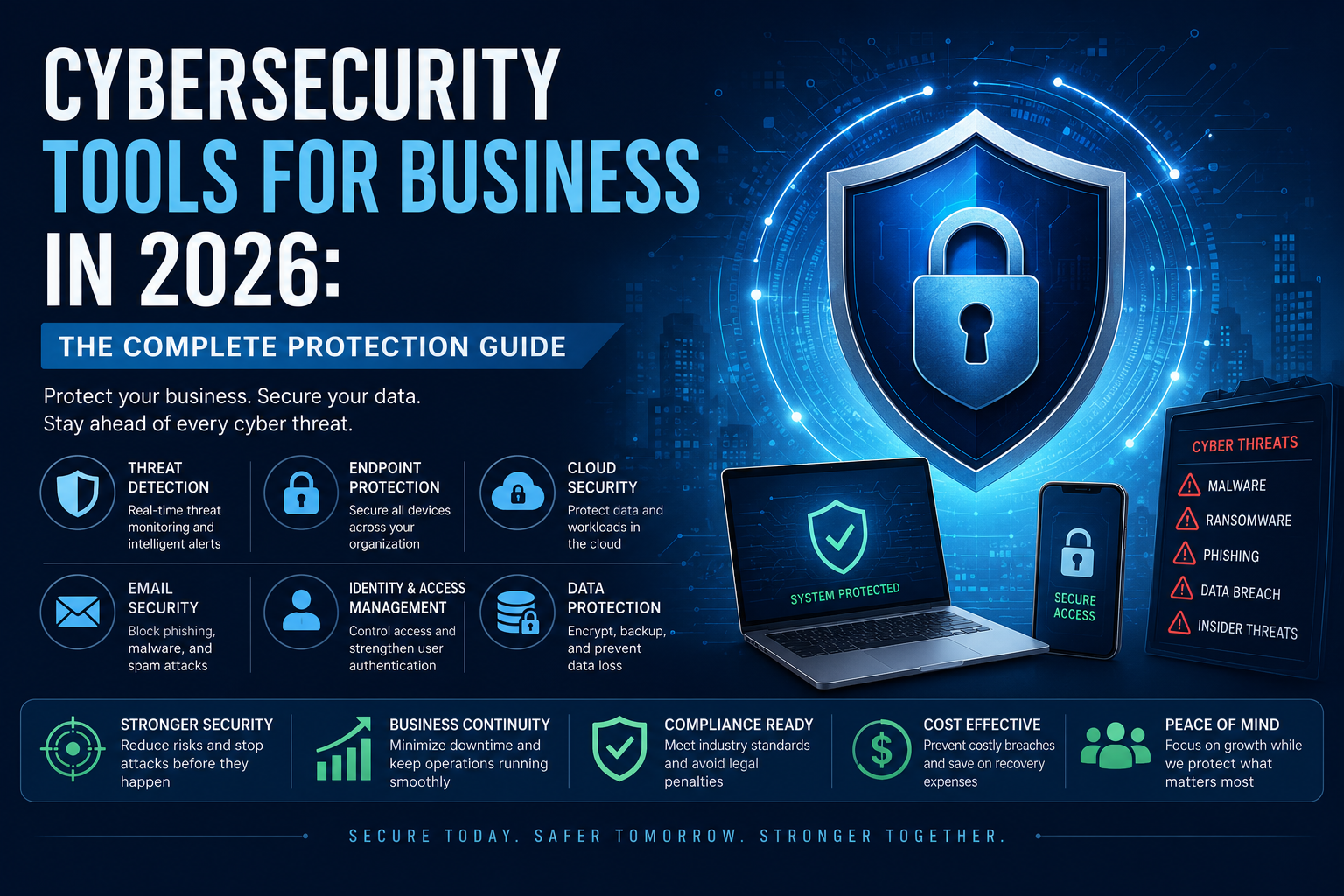
Cybersecurity Tools for Business in 2026: The Complete Protection Guide
Introduction
In 2026, a cyberattack occurs somewhere in the world every 39 seconds. Businesses of all sizes — from solo entrepreneurs to Fortune 500 companies — are targets. And the consequences of a successful attack are devastating: financial losses, reputational damage, legal liability, and in some cases, complete business shutdown.
The good news is that the right cybersecurity tools can protect your business from the vast majority of threats. You do not need a team of 50 security experts or a multi-million dollar budget. What you need is the right combination of tools, properly implemented and consistently maintained.
This guide covers everything you need to know about cybersecurity tools for business — what threats you face, which tool categories matter most, the top products in each category, and how to build a layered security strategy that actually works.
The Cybersecurity Threat Landscape in 2026
Before choosing tools, you need to understand what you are protecting against. Here are the most significant threats businesses face today:
Ransomware
Ransomware is malicious software that encrypts your files and demands payment — often in cryptocurrency — for the decryption key. In 2026, ransomware attacks cost businesses an average of $4.5 million per incident when you factor in downtime, recovery costs, ransom payments, and reputational damage. Small businesses are disproportionately targeted because they typically have weaker defenses.
Phishing and Social Engineering
Phishing is the number one entry point for cyberattacks. Criminals send emails that appear to come from trusted sources — your bank, your CEO, a vendor — tricking employees into clicking malicious links or handing over login credentials. Modern phishing attacks are frighteningly convincing, often using AI to personalize messages at scale.
Data Breaches
A data breach occurs when unauthorized parties gain access to sensitive business or customer data. The average cost of a data breach in 2026 is $4.88 million according to IBM’s annual report. Beyond the financial cost, breaches trigger regulatory fines, lawsuits, and lasting damage to customer trust.
Insider Threats
Not all threats come from outside. Disgruntled employees, careless staff clicking on phishing links, or employees sharing passwords are among the most common causes of security incidents. Insider threats are particularly dangerous because they bypass perimeter defenses.
Zero-Day Exploits
These are vulnerabilities in software that are unknown to the vendor — meaning no patch exists yet. Sophisticated attackers exploit these windows of vulnerability before fixes are released.
Supply Chain Attacks
Attackers compromise a trusted software vendor or service provider and use that access to reach the vendor’s customers. The SolarWinds attack of 2020 demonstrated just how catastrophic supply chain attacks can be, affecting thousands of organizations worldwide.
DDoS Attacks
Distributed Denial of Service attacks flood your servers or network with traffic until they crash, taking your website and services offline. For e-commerce businesses, even a few hours of downtime can cost hundreds of thousands of dollars.
Why Traditional Security Is No Longer Enough
Many businesses still rely on a simple antivirus program and a basic firewall — tools designed for the threat landscape of the early 2000s. Today’s attacks are dramatically more sophisticated:
- Antivirus software that relies on known virus signatures cannot detect new, unknown malware
- Perimeter firewalls cannot protect against attacks that originate from inside the network (insider threats, compromised employee accounts)
- Password-only authentication is trivially broken through phishing, credential stuffing, and brute force attacks
- A single security tool cannot cover all attack vectors
Modern cybersecurity requires a layered, defense-in-depth approach — multiple tools working together to detect, prevent, and respond to threats across all vectors.
The Essential Categories of Cybersecurity Tools
Here are the core categories every business needs to have covered:
1. Endpoint Detection and Response (EDR)
2. Firewall and Network Security
3. Identity and Access Management (IAM)
4. Multi-Factor Authentication (MFA)
5. Email Security
6. Password Management
7. VPN and Zero Trust Network Access
8. Data Backup and Recovery
9. Security Awareness Training
10. Vulnerability Management and Scanning
11. SIEM (Security Information and Event Management)
12. Cloud Security
Let us explore each category in detail with the top tools in each.
1. Endpoint Detection and Response (EDR)
EDR tools monitor every device (endpoint) on your network — laptops, desktops, servers, mobile devices — in real time, detecting and responding to threats automatically. Unlike traditional antivirus, EDR uses behavioral analysis and AI to catch threats that have never been seen before.
Why it matters: Most attacks begin at the endpoint. An employee clicks a phishing link, downloads a malicious file, or connects to a compromised network. EDR is your last line of defense at the device level.
Top EDR Tools:
CrowdStrike Falcon
The gold standard in enterprise EDR. CrowdStrike uses AI-powered threat detection that analyzes trillions of events per week across its global customer base. Its Falcon platform provides real-time visibility, automatic threat containment, and detailed forensic investigation capabilities.
- Best for: Mid to large enterprises
- Pricing: From $8.99/endpoint/month
- Key strength: Industry-leading detection rates, cloud-native architecture, minimal performance impact
SentinelOne
SentinelOne’s Singularity platform provides autonomous threat detection and response — it can detect, isolate, and remediate threats without human intervention. Its rollback capability can reverse damage caused by ransomware, restoring files to their pre-attack state.
- Best for: Businesses wanting autonomous response
- Pricing: From $69.99/endpoint/year
- Key strength: Autonomous remediation, excellent ransomware rollback
Microsoft Defender for Endpoint
If your organization runs Windows, Microsoft Defender for Endpoint is already built in and has become genuinely enterprise-grade. It integrates deeply with the Microsoft 365 ecosystem and provides strong protection at a fraction of the cost of standalone solutions.
- Best for: Microsoft-centric organizations
- Pricing: Included with Microsoft 365 Business Premium ($22/user/month)
- Key strength: Seamless Windows integration, excellent value
Malwarebytes for Teams
A more affordable option well-suited to small and medium businesses. Malwarebytes provides strong malware detection, real-time protection, and a simple management console that does not require a dedicated security team to operate.
- Best for: Small businesses
- Pricing: From $4.99/device/month
- Key strength: Easy to manage, great value
2. Firewall and Network Security
A firewall monitors and controls incoming and outgoing network traffic based on security rules. Next-generation firewalls (NGFW) go further, providing deep packet inspection, application awareness, intrusion prevention, and integrated threat intelligence.
Why it matters: Your firewall is the gatekeeper between your internal network and the outside world. Without a properly configured firewall, attackers can probe your systems, exploit open ports, and establish unauthorized connections.
Top Firewall Solutions:
Palo Alto Networks Next-Generation Firewall
The industry leader in enterprise firewall technology. Palo Alto’s NGFWs provide application-level visibility, advanced threat prevention, URL filtering, and integrated sandboxing for zero-day threat detection.
- Best for: Large enterprises
- Pricing: Hardware appliances from $1,000+; cloud-delivered Prisma Access from $18/user/month
- Key strength: Best-in-class threat prevention, excellent application visibility
Fortinet FortiGate
FortiGate is one of the most widely deployed firewall platforms in the world, particularly popular with mid-market businesses. It delivers enterprise-grade security at a more accessible price point, with a comprehensive security operating system (FortiOS) that manages all security functions from one console.
- Best for: Mid-size businesses
- Pricing: Hardware from $300; cloud from $500/month
- Key strength: Excellent price-performance ratio, comprehensive feature set
Sophos XG Firewall
Sophos is particularly popular with managed service providers (MSPs) and businesses that want strong security with simpler management. Its synchronized security feature allows the firewall and endpoint protection to communicate and automatically respond to threats.
- Best for: SMBs and MSP-managed businesses
- Pricing: From $1,000/year for hardware and license
- Key strength: Synchronized security, excellent management interface
Cisco Meraki MX
Meraki is a cloud-managed networking solution that makes enterprise-grade security accessible to businesses without dedicated IT staff. Everything is managed through a simple web dashboard — no command-line configuration required.
- Best for: Businesses without dedicated IT teams
- Pricing: From $1,000/year per device
- Key strength: Incredibly easy to manage, excellent visibility
3. Identity and Access Management (IAM)
IAM tools control who can access what within your organization. They enforce the principle of least privilege — ensuring every user has access only to the systems and data they need for their specific role, and nothing more.
Why it matters: Compromised credentials are involved in over 80% of data breaches. IAM tools limit the damage an attacker can do even if they obtain valid credentials.
Top IAM Solutions:
Okta
Okta is the leading identity platform for businesses. It provides single sign-on (SSO) across all your applications, automated user provisioning and deprovisioning, adaptive multi-factor authentication, and a powerful lifecycle management system.
- Best for: Mid to large businesses with many SaaS applications
- Pricing: From $2/user/month for SSO; from $5/user/month for full lifecycle management
- Key strength: Largest app integration library (7,000+ apps), excellent user experience
Microsoft Entra ID (formerly Azure AD)
For organizations in the Microsoft ecosystem, Entra ID is the natural choice. It provides SSO, MFA, conditional access policies, and identity governance, all deeply integrated with Microsoft 365 and Azure.
- Best for: Microsoft-centric organizations
- Pricing: Free basic tier; P1 from $6/user/month; P2 from $9/user/month
- Key strength: Deep Microsoft integration, powerful conditional access
JumpCloud
JumpCloud is an excellent choice for small to medium businesses, offering directory services, SSO, MFA, and device management in a single platform. It supports Windows, Mac, and Linux environments.
- Best for: SMBs with mixed device environments
- Pricing: Free for up to 10 users; from $11/user/month after that
- Key strength: Multi-OS support, comprehensive feature set at SMB prices
4. Multi-Factor Authentication (MFA)
MFA requires users to verify their identity through two or more methods before accessing systems — typically something they know (password), something they have (phone app or hardware token), and something they are (biometrics).
Why it matters: MFA alone can prevent 99.9% of automated account compromise attacks according to Microsoft. It is arguably the single highest-impact security control a business can implement.
Top MFA Solutions:
Duo Security (by Cisco)
Duo is the most widely used MFA solution for businesses. It is device-agnostic, supports push notifications, hardware tokens, and biometrics, and includes a powerful device health assessment that checks whether devices meet security requirements before granting access.
- Best for: All business sizes
- Pricing: Free for up to 10 users; Essentials from $3/user/month
- Key strength: Excellent user experience, strong device trust features
Google Authenticator / Microsoft Authenticator
These free authenticator apps generate time-based one-time passwords (TOTP) for MFA. While they lack enterprise management features, they are excellent free options for very small businesses or as a starting point.
- Best for: Very small businesses and individuals
- Pricing: Free
- Key strength: Free, widely supported
YubiKey (by Yubico)
YubiKeys are physical hardware tokens that plug into a USB port or tap via NFC. They provide the strongest form of phishing-resistant MFA available. Even if an employee enters their credentials on a fake website, the YubiKey will not authenticate because the site’s domain does not match.
- Best for: High-security environments, executives, finance teams
- Pricing: From $25 per key (one-time purchase)
- Key strength: Phishing-resistant, no app or network connection needed
5. Email Security
Email is the single most common attack vector for businesses. Phishing, malware attachments, business email compromise (BEC), and spam all arrive through your inbox. Email security tools filter, analyze, and block malicious messages before they reach your employees.
Why it matters: Over 90% of cyberattacks begin with a phishing email. A single employee clicking the wrong link can compromise your entire organization.
Top Email Security Solutions:
Proofpoint Email Security
Proofpoint is the enterprise standard for email security. It combines advanced threat detection (including analysis of URLs and attachments in a sandbox), impersonation protection, and comprehensive data loss prevention. Its threat intelligence is powered by analysis of billions of messages per day.
- Best for: Large enterprises
- Pricing: From $2/user/month for essentials; $6+/user/month for advanced
- Key strength: Industry-leading detection rates, comprehensive threat intelligence
Mimecast
Mimecast provides email security, continuity, and archiving in one platform. Its targeted threat protection identifies and blocks spear-phishing, impersonation attacks, and malicious URLs in real time.
- Best for: Mid-size businesses
- Pricing: From $3.50/user/month
- Key strength: Email continuity (keeps email working even if your mail server goes down), strong archiving
Microsoft Defender for Office 365
For organizations on Microsoft 365, Defender for Office 365 (included in Business Premium and higher plans) provides solid email protection including safe links, safe attachments, anti-phishing policies, and attack simulation training.
- Best for: Microsoft 365 users
- Pricing: Included with Microsoft 365 Business Premium ($22/user/month)
- Key strength: Native integration, no additional vendor to manage
Google Workspace Security
Google Workspace includes strong built-in email security with Gmail’s advanced phishing and malware protection, which filters billions of spam messages per day. Enhanced security features are available in Business Plus and Enterprise plans.
- Best for: Google Workspace users
- Pricing: Included in all Google Workspace plans
- Key strength: Excellent AI-based spam detection, integrated with Google ecosystem
6. Password Management
Weak and reused passwords are one of the most exploitable vulnerabilities in any organization. A business password manager generates, stores, and auto-fills strong, unique passwords for every account — and ensures employees never need to know or remember them.
Why it matters: The average person reuses the same password across 14 different accounts. When one account is breached, all others become vulnerable. Password managers eliminate this risk entirely.
Top Business Password Managers:
1Password Business
1Password is widely considered the best business password manager available. Its Travel Mode (hiding sensitive vaults at border crossings), Secret Key architecture, and beautifully designed apps make it a favorite among security-conscious organizations.
- Best for: Businesses of all sizes
- Pricing: $7.99/user/month
- Key strength: Excellent UX, strong security architecture, great admin controls
Bitwarden
Bitwarden is the leading open-source password manager. Its code is publicly audited, making it transparent and trustworthy. It offers an impressive free tier and very competitive business pricing — a favorite among security professionals.
- Best for: Security-conscious and budget-aware businesses
- Pricing: Free for individuals; Teams from $3/user/month; Enterprise from $5/user/month
- Key strength: Open source, excellent value, self-hosting option available
Dashlane Business
Dashlane includes a built-in VPN, dark web monitoring that alerts you when company credentials appear in breach databases, and strong admin controls for enforcing password policies.
- Best for: Businesses wanting combined password management and monitoring
- Pricing: From $8/user/month
- Key strength: Dark web monitoring, built-in VPN, excellent breach alerts
LastPass Business
LastPass is one of the most widely deployed business password managers globally, though it has faced criticism following a 2022 breach. Its recovery has been significant and it remains a capable, feature-rich option.
- Best for: Organizations already using LastPass
- Pricing: From $4/user/month
- Key strength: Comprehensive admin controls, wide SSO integration
7. VPN and Zero Trust Network Access (ZTNA)
A Virtual Private Network (VPN) encrypts internet traffic and masks users’ IP addresses, creating a secure tunnel between remote employees and corporate resources. Zero Trust Network Access goes further — it verifies every user and device before granting access to specific applications, regardless of whether they are inside or outside the network.
Why it matters: Remote and hybrid work means employees access company systems from home networks, coffee shops, and airports — all potentially insecure. VPN and ZTNA ensure these connections are encrypted and authenticated.
Top VPN and ZTNA Solutions:
Cloudflare Zero Trust
Cloudflare’s ZTNA solution (formerly Cloudflare Access) replaces traditional VPNs with identity-aware, application-specific access controls. It is fast, extremely secure, and includes DDoS protection, secure web gateway, and email security in the same platform.
- Best for: Modern businesses moving beyond traditional VPN
- Pricing: Free for up to 50 users; Teams from $7/user/month
- Key strength: Excellent performance, comprehensive Zero Trust platform, strong free tier
Cisco AnyConnect
The enterprise standard for VPN, deployed by thousands of large organizations worldwide. AnyConnect provides robust remote access with strong endpoint compliance checking.
- Best for: Large enterprises with existing Cisco infrastructure
- Pricing: From $30/user/year (requires Cisco ASA or FTD hardware)
- Key strength: Enterprise reliability, deep Cisco integration
NordLayer (by Nord Security)
NordLayer is the business version of NordVPN, providing site-to-site VPN, dedicated gateways, and basic ZTNA features. It is an accessible and affordable option for SMBs that need VPN without enterprise complexity.
- Best for: Small and medium businesses
- Pricing: From $8/user/month
- Key strength: Easy setup, affordable, reputable Nord brand
8. Data Backup and Recovery
Every other security tool exists to prevent attacks. Backup and recovery tools exist for when prevention fails. A robust backup strategy ensures that even in the worst-case scenario — a successful ransomware attack, a hardware failure, or a natural disaster — your business can recover quickly with minimal data loss.
Why it matters: 60% of small businesses that suffer a significant data loss shut down within 6 months. A reliable backup is not optional — it is an existential necessity.
The 3-2-1 Backup Rule
The industry-standard backup strategy:
- 3 copies of your data
- 2 on different storage media
- 1 stored offsite (preferably cloud)
Top Backup Solutions:
Veeam Backup and Replication
Veeam is the enterprise standard for backup and disaster recovery, protecting physical servers, virtual machines, and cloud workloads. Its instant recovery feature can have a failed server back online in minutes by running it directly from the backup.
- Best for: Mid to large enterprises
- Pricing: From $224/year per socket
- Key strength: Industry-leading recovery speed, broad platform support
Acronis Cyber Protect
Acronis uniquely combines backup with cybersecurity — anti-ransomware, vulnerability assessment, and patch management are built into the same agent as the backup software. This integration means that if ransomware is detected, Acronis can automatically stop the attack and restore affected files from backup.
- Best for: SMBs wanting backup and security combined
- Pricing: From $85/year per device
- Key strength: Unique backup + security integration, excellent anti-ransomware
Backblaze Business Backup
Backblaze offers unlimited cloud backup for an extremely affordable flat monthly fee. It is simple to set up, runs silently in the background, and provides continuous backup of all files on enrolled computers.
- Best for: Small businesses on tight budgets
- Pricing: $7/computer/month
- Key strength: Unlimited storage, extremely affordable, very easy to use
Datto BCDR
Datto specializes in Business Continuity and Disaster Recovery (BCDR) solutions. Its hybrid backup appliances store local backups for fast recovery and replicate to the cloud for offsite protection. In a major disaster, Datto can spin up your entire server environment in the cloud within minutes.
- Best for: Businesses needing maximum uptime and fast disaster recovery
- Pricing: From $500/month (often sold through MSPs)
- Key strength: Industry-best recovery time objectives, local + cloud hybrid
9. Security Awareness Training
Technology alone cannot protect your business if your employees click on phishing emails, share passwords, or plug unknown USB drives into company computers. Security awareness training educates employees about cyber threats and teaches them how to recognize and respond to attacks.
Why it matters: Human error is responsible for 95% of cybersecurity incidents. Training your people is as important as deploying technical tools.
Top Security Training Platforms:
KnowBe4
KnowBe4 is the world’s largest security awareness training platform. It combines a vast library of training content (videos, interactive modules, games) with automated phishing simulation — sending fake phishing emails to employees and immediately training those who click.
- Best for: All business sizes
- Pricing: From $24/user/year
- Key strength: Largest content library, excellent phishing simulation, strong reporting
Proofpoint Security Awareness Training
Proofpoint’s training platform focuses on identifying your most vulnerable employees (Very Attacked Persons or VAPs) and delivering targeted training to those at highest risk. It integrates with Proofpoint’s email security for seamless threat intelligence.
- Best for: Organizations using Proofpoint email security
- Pricing: Custom pricing based on organization size
- Key strength: Risk-based targeting, deep email security integration
Cofense
Cofense specializes specifically in phishing defense. Its platform combines phishing simulation with a PhishMe reporter button that employees can use to report suspicious emails — turning your workforce into an active part of your security team.
- Best for: Organizations focused on phishing defense
- Pricing: From $10/user/year
- Key strength: Excellent phishing simulation, strong employee reporting culture
10. Vulnerability Management
Vulnerability management tools continuously scan your systems, applications, and network infrastructure to identify security weaknesses — unpatched software, misconfigured settings, weak passwords, and known vulnerabilities — before attackers can exploit them.
Why it matters: There are an average of 25,000+ new vulnerabilities discovered every year. Without continuous scanning, your organization is almost certainly running software with known, exploitable security flaws.
Top Vulnerability Management Tools:
Tenable Nessus
Nessus is the most widely deployed vulnerability scanner in the world. It scans networks, systems, and applications for thousands of known vulnerabilities and provides prioritized remediation guidance.
- Best for: All business sizes
- Pricing: Nessus Essentials free for up to 16 IPs; Professional from $3,990/year
- Key strength: Comprehensive coverage, trusted by millions of security professionals
Qualys VMDR
Qualys provides cloud-based vulnerability management with continuous monitoring across on-premise, cloud, and remote assets. Its VMDR (Vulnerability Management, Detection, and Response) platform correlates vulnerability data with threat intelligence to prioritize the most critical risks.
- Best for: Large enterprises with complex environments
- Pricing: Custom enterprise pricing
- Key strength: Continuous monitoring, excellent cloud asset coverage
Rapid7 InsightVM
InsightVM provides live vulnerability data with real-risk scoring — factoring in not just the severity of a vulnerability but also whether it is actually being exploited in the wild. Its remediation projects feature tracks vulnerability fixes across teams.
- Best for: Mid to large enterprises
- Pricing: From $2.19/asset/month
- Key strength: Real-risk scoring, excellent remediation tracking
Building Your Cybersecurity Stack: A Layered Approach
Here is how to build a comprehensive, layered security strategy based on your business size:
Small Business (1–25 employees) — Essential Stack
| Tool Category | Recommended Solution | Approx. Cost |
|---|---|---|
| Endpoint Protection | Malwarebytes for Teams | $5/device/month |
| Password Manager | Bitwarden Teams | $3/user/month |
| MFA | Duo Free / Microsoft Authenticator | Free |
| Email Security | Microsoft 365 Business Premium (includes Defender) | $22/user/month |
| Backup | Backblaze Business | $7/computer/month |
| Security Training | KnowBe4 Silver | $24/user/year |
| Firewall | Sophos XG or Meraki MX | $500–$1,500/year |
Estimated total: $30–$40/user/month — a very achievable investment that provides strong protection.
Medium Business (25–250 employees) — Advanced Stack
| Tool Category | Recommended Solution |
|---|---|
| EDR | CrowdStrike Falcon or SentinelOne |
| Firewall/NGFW | Fortinet FortiGate |
| IAM/SSO | Okta or Microsoft Entra ID |
| MFA | Duo Security |
| Email Security | Proofpoint or Mimecast |
| Password Manager | 1Password Business |
| VPN/ZTNA | Cloudflare Zero Trust |
| Backup | Acronis Cyber Protect or Veeam |
| Vulnerability Scanning | Nessus Professional |
| Security Training | KnowBe4 |
Large Enterprise (250+ employees) — Enterprise Stack
Large enterprises typically add:
- SIEM platform (Splunk, Microsoft Sentinel, IBM QRadar) for centralized log management and threat detection
- SOC (Security Operations Center) — either in-house or outsourced to an MSSP
- Zero Trust Architecture across all network segments
- DLP (Data Loss Prevention) tools
- Threat Intelligence Platforms
- Penetration testing on a regular schedule
- Incident Response retainer with a cybersecurity firm
Cybersecurity Compliance Frameworks
Depending on your industry, you may be required to comply with specific cybersecurity standards:
ISO 27001
International standard for information security management systems. Demonstrates to clients and partners that your organization takes security seriously. Required by many large enterprise procurement processes.
SOC 2
A compliance framework for service organizations that store or process customer data. Increasingly required by enterprise customers before signing contracts with SaaS vendors.
GDPR (General Data Protection Regulation)
European data protection law that applies to any business handling EU residents’ personal data. Violations can result in fines of up to 4% of global annual revenue.
HIPAA
US healthcare data protection law. Any business handling protected health information (PHI) must comply with strict security and privacy requirements.
PCI DSS
Payment Card Industry Data Security Standard. Required for any business that accepts, processes, stores, or transmits credit card information.
The cybersecurity tools described in this guide form the technical foundation required to comply with most of these frameworks.
The True Cost of a Cyberattack vs. the Cost of Prevention
Here is the financial reality that every business owner needs to understand:
| Cost Item | Average Cost |
|---|---|
| Average ransomware recovery cost | $1.85 million |
| Average data breach cost (global) | $4.88 million |
| Average downtime per ransomware attack | 21 days |
| Average cost of reputational damage | $1.6 million |
| Average annual cybersecurity tool budget (SMB) | $15,000–$50,000 |
The math is clear: the cost of prevention is a fraction of the cost of a single successful attack. Cybersecurity is not an IT expense — it is business insurance.
Key Cybersecurity Best Practices Beyond Tools
Even the best tools fail if these fundamental practices are not in place:
Patch and update everything — immediately
The majority of successful cyberattacks exploit known vulnerabilities that patches already exist for. Enable automatic updates for all software and operating systems. Never delay security patches.
Segment your network
Do not put everything on one flat network. Separate your finance systems from your general employee network. Separate IoT devices. If one segment is compromised, segmentation limits the blast radius.
Enforce least privilege access
Every employee should have access only to the systems and data they need for their specific job. No more, no less. Review and revoke permissions when roles change.
Conduct regular security audits
At least annually, conduct a comprehensive review of your security posture — who has access to what, which systems are exposed, what vulnerabilities exist, and whether your tools are configured correctly.
Create and test an incident response plan
You need a written plan for what to do when (not if) you are attacked. Who is notified? Who makes decisions? How is the attack contained? Who communicates with customers? Practice the plan before you need it.
Cyber insurance
Cybersecurity insurance has become essential. A good policy covers ransom payments, recovery costs, legal fees, and business interruption losses. Ensure your policy specifically covers ransomware and social engineering attacks.
Conclusion
Cybersecurity is no longer something businesses can treat as optional or delegate entirely to an IT team. In 2026, it is a fundamental business risk that demands the attention of leadership, adequate budget, and a coherent strategy.
The good news is that you do not need to solve this overnight or spend a fortune. Start with the essentials — endpoint protection, MFA, email security, backups, and employee training — and build from there. A layered, defense-in-depth approach using the right combination of tools can protect the vast majority of businesses from the vast majority of threats.