Introduction
Running a small business means managing customers, tracking sales, following up with leads, and providing excellent customer service—all with limited time and resources. This is where CRM for Small Business becomes essential.
A Customer Relationship Management (CRM) system helps businesses organize customer data, automate repetitive tasks, improve communication, and increase sales. In 2026, cloud-based CRM solutions have become more affordable and powerful, making them an essential investment for startups and growing businesses.
This guide explains everything you need to know about CRM for small businesses, including its benefits, features, pricing, and how to choose the right solution.
What Is CRM for Small Business?
A CRM (Customer Relationship Management) system is software that helps businesses manage customer interactions, sales opportunities, marketing campaigns, and customer support from one centralized platform.
Instead of using spreadsheets or notebooks, businesses can securely store all customer information in one place.
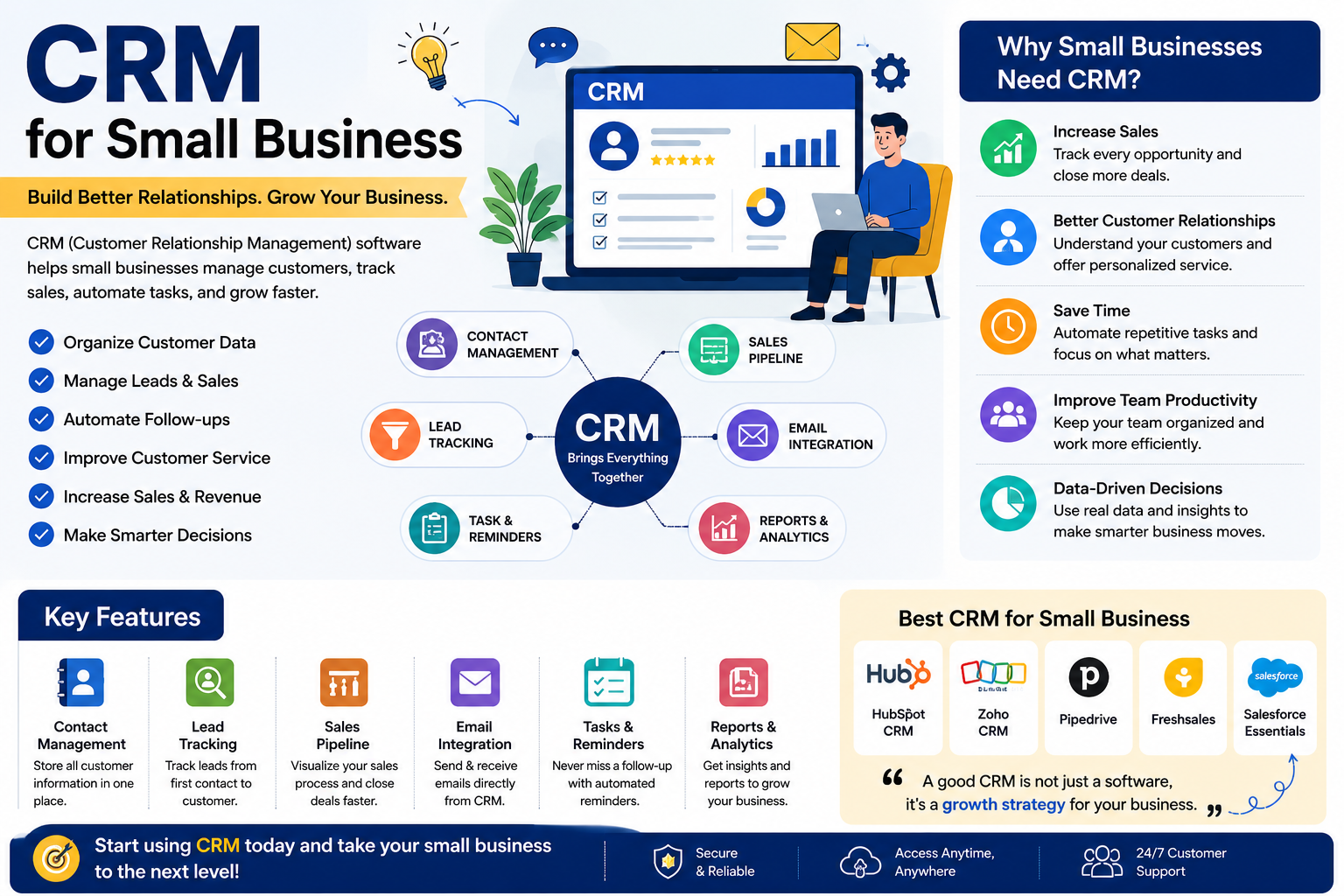
Why Small Businesses Need CRM
Many small businesses lose potential customers because they forget follow-ups, misplace contact information, or fail to track sales opportunities.
CRM software solves these problems by helping businesses:
- Manage customer contacts
- Track sales pipelines
- Automate follow-ups
- Improve customer communication
- Increase team productivity
- Boost customer retention
- Generate detailed business reports
Key Features of CRM for Small Business
Contact Management
Store customer details, including names, phone numbers, emails, company information, and communication history.
Lead Tracking
Monitor every lead from initial inquiry to final purchase.
Benefits include:
- Better lead organization
- Faster response times
- Higher conversion rates
Sales Pipeline Management
Visualize every stage of the sales process, from new leads to closed deals.
Email Integration
Connect Gmail or Outlook to send and receive emails directly from your CRM dashboard.
Task & Appointment Management
Automatically schedule:
- Follow-up calls
- Client meetings
- Email reminders
- Daily tasks
Reporting & Analytics
Measure business performance with reports on:
- Sales growth
- Customer acquisition
- Revenue
- Conversion rates
- Employee productivity
Benefits of CRM for Small Business
Using CRM software can help small businesses:
Increase Sales
Track every opportunity and ensure no lead is missed.
Improve Customer Relationships
Maintain a complete history of customer interactions for personalized service.
Save Time
Automate repetitive tasks like reminders and follow-up emails.
Boost Productivity
Allow employees to focus on selling instead of administrative work.
Make Better Decisions
Access real-time reports and customer insights.
Best CRM Software for Small Business in 2026
HubSpot CRM
Ideal for startups with a generous free plan and easy-to-use interface.
Zoho CRM
Affordable solution with automation, analytics, and AI features.
Pipedrive
Excellent for businesses focused on managing sales pipelines.
Freshsales
Offers AI-powered lead scoring and sales automation.
Salesforce Essentials
A powerful CRM solution designed for growing businesses.
How to Choose the Right CRM
Before purchasing CRM software, consider:
- Your business size
- Budget
- Ease of use
- Automation features
- Mobile app availability
- Third-party integrations
- Customer support
- Data security
- Scalability
Common Mistakes to Avoid
Many businesses make these CRM mistakes:
- Not training employees
- Using incomplete customer data
- Ignoring CRM reports
- Choosing overly complicated software
- Failing to automate routine tasks
Future Trends
CRM software continues to evolve with:
- Artificial Intelligence (AI)
- Marketing automation
- Predictive analytics
- Voice assistants
- AI chatbots
- Customer behavior tracking
- Workflow automation
- Cloud-based collaboration
Frequently Asked Questions
What is the best CRM for small businesses?
Popular options include HubSpot CRM, Zoho CRM, Pipedrive, Freshsales, and Salesforce Essentials.
Is CRM expensive?
Many CRM providers offer free plans and affordable monthly subscriptions suitable for small businesses.
Can CRM help increase sales?
Yes. CRM software improves lead management, customer follow-ups, and sales tracking, leading to higher conversion rates.
Is cloud CRM secure?
Yes. Leading CRM providers use encryption, regular backups, and advanced security measures to protect customer data.
Conclusion
CRM software has become an essential tool for small businesses looking to improve customer relationships, increase sales, and streamline daily operations. By choosing the right CRM platform, businesses can automate repetitive tasks, gain valuable customer insights, and create better experiences that drive long-term growth. Investing in a reliable CRM in 2026 is one of the smartest decisions any small business can make.