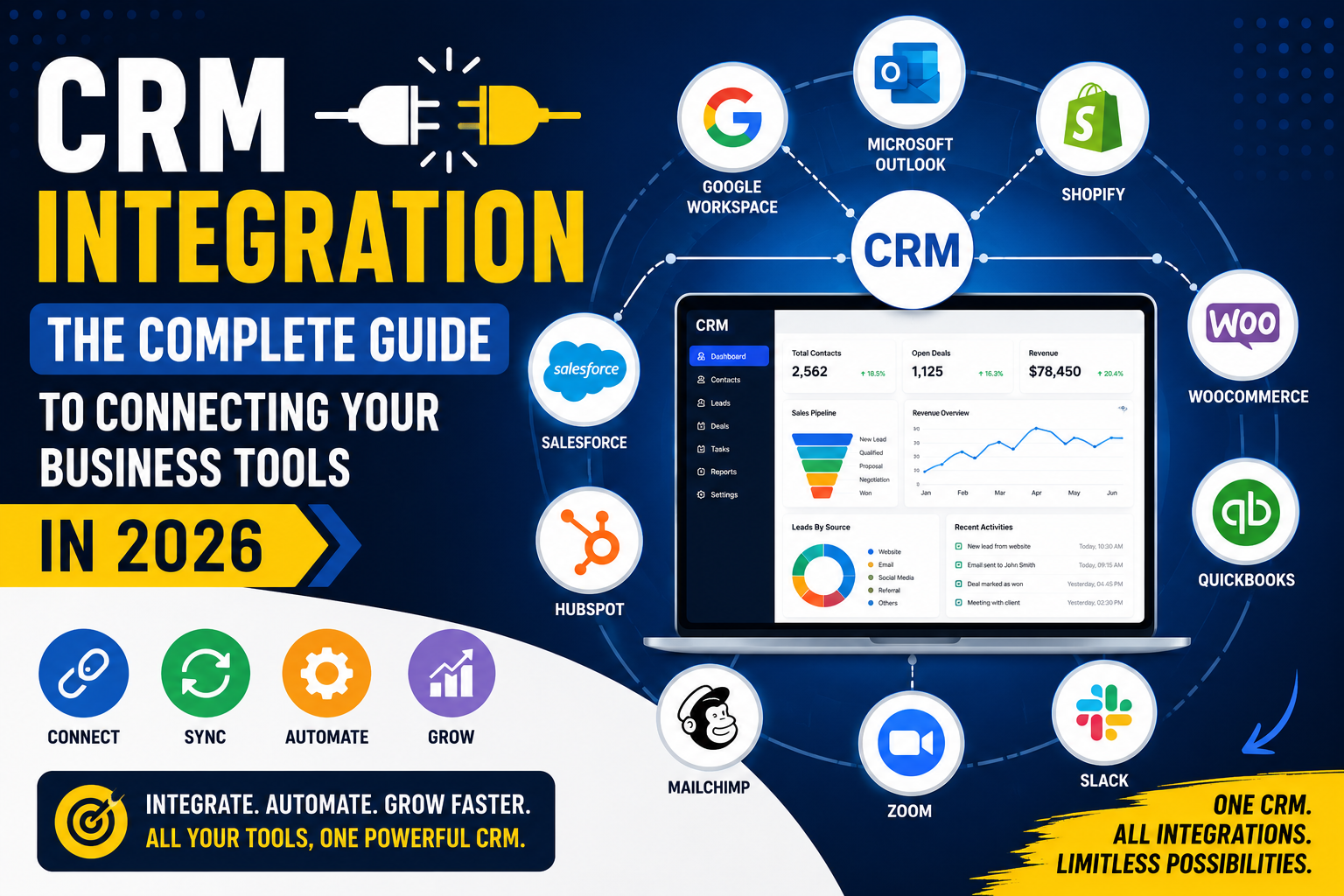
Modern businesses use dozens of software applications every day, including email platforms, accounting software, marketing tools, customer support systems, eCommerce stores, and payment gateways. Managing these systems separately wastes time and often leads to inconsistent customer data.
CRM Integration solves this challenge by connecting your Customer Relationship Management (CRM) platform with the tools your business already uses. Instead of switching between multiple applications, teams can access all customer information from a single dashboard, improving efficiency, collaboration, and decision-making.
In this comprehensive guide, you’ll learn what CRM integration is, why it matters, the different types of integrations available, and how it can transform your business operations in 2026.
What Is CRM Integration?
CRM Integration is the process of connecting your CRM software with other business applications so that data flows automatically between them.
Instead of manually copying information from one system to another, integrated software keeps customer records updated in real time. This reduces errors, saves time, and ensures every department has access to accurate information.
Why CRM Integration Is Important
Without integration, businesses often face problems such as:
- Duplicate customer records
- Manual data entry
- Delayed communication
- Missed sales opportunities
- Inaccurate reporting
- Poor customer experience
CRM integration eliminates these issues by creating a centralized system where all customer information is synchronized automatically.
Benefits of CRM Integration
Improved Productivity
Employees spend less time entering data manually and more time focusing on sales, marketing, and customer service.
Better Customer Experience
Integrated systems provide a complete view of every customer, allowing businesses to deliver faster and more personalized support.
Accurate Data
Automatic synchronization reduces human errors and ensures that every department works with the same information.
Faster Decision-Making
Managers can access real-time dashboards that combine sales, marketing, and customer support data in one place.
Increased Sales
Sales teams can respond to leads faster because all customer interactions are available inside the CRM.
Types of CRM Integrations
Email Integration
Connect your CRM with Gmail or Outlook to automatically track emails, schedule follow-ups, and manage customer communication.
Benefits
- Email tracking
- Contact synchronization
- Automated follow-ups
- Meeting scheduling
Marketing Automation Integration
Integrating marketing platforms allows businesses to:
- Track campaigns
- Score leads
- Measure ROI
- Automate email marketing
eCommerce Integration
Online stores can connect platforms like Shopify or WooCommerce with CRM software to:
- Sync customer data
- Track purchases
- Manage abandoned carts
- Recommend products
Accounting Integration
Accounting software integration helps businesses:
- Generate invoices
- Track payments
- Monitor revenue
- Reduce manual bookkeeping
Customer Support Integration
Help desk integration enables businesses to:
- View customer tickets
- Track support history
- Improve response times
- Increase customer satisfaction
Communication Tools Integration
Connect your CRM with:
- WhatsApp Business
- Slack
- Microsoft Teams
- Zoom
This improves collaboration and customer communication.
How CRM Integration Works
Most modern CRM platforms use APIs (Application Programming Interfaces) to exchange information with other software.
For example:
- A customer submits a form on your website.
- The CRM automatically creates a new contact.
- The sales team receives a notification.
- A welcome email is sent automatically.
- Marketing workflows begin without manual intervention.
This entire process happens within seconds.
Best CRM Integrations in 2026
Popular CRM integrations include:
- Google Workspace
- Microsoft 365
- Mailchimp
- Shopify
- WooCommerce
- Stripe
- PayPal
- Slack
- Zoom
- QuickBooks
Common CRM Integration Challenges
Businesses may encounter:
- Data duplication
- API limitations
- Security concerns
- Integration compatibility
- Employee training requirements
Proper planning and testing can minimize these issues.
Best Practices for CRM Integration
To achieve the best results:
- Define your business goals before integrating.
- Clean existing customer data.
- Choose trusted integration tools.
- Test integrations before deployment.
- Monitor data synchronization regularly.
- Train employees on the new workflows.
Future Trends in CRM Integration
CRM integration continues to evolve with technologies such as:
- Artificial Intelligence (AI)
- Machine Learning
- Predictive Analytics
- No-Code Automation
- Voice Assistants
- Real-Time Data Synchronization
- Intelligent Workflow Automation
These innovations will make CRM systems even more powerful and easier to manage.
Frequently Asked Questions
What is CRM Integration?
CRM Integration connects your CRM with other business applications to automatically share customer data and improve workflow efficiency.
Why is CRM Integration important?
It eliminates manual data entry, improves collaboration, enhances customer experience, and provides accurate business insights.
Can small businesses benefit from CRM Integration?
Yes. Even small businesses can save time, improve customer service, and increase sales through CRM integration.
Is CRM Integration secure?
Most modern CRM platforms use encrypted connections and secure APIs to protect customer information during data synchronization.
Conclusion
CRM Integration is no longer a luxury—it’s a necessity for businesses that want to stay competitive in 2026. By connecting your CRM with email platforms, eCommerce stores, accounting software, and communication tools, you can automate workflows, improve customer experiences, and make smarter business decisions. Whether you’re a startup or a large enterprise, implementing CRM integration will help streamline operations and support long-term growth.