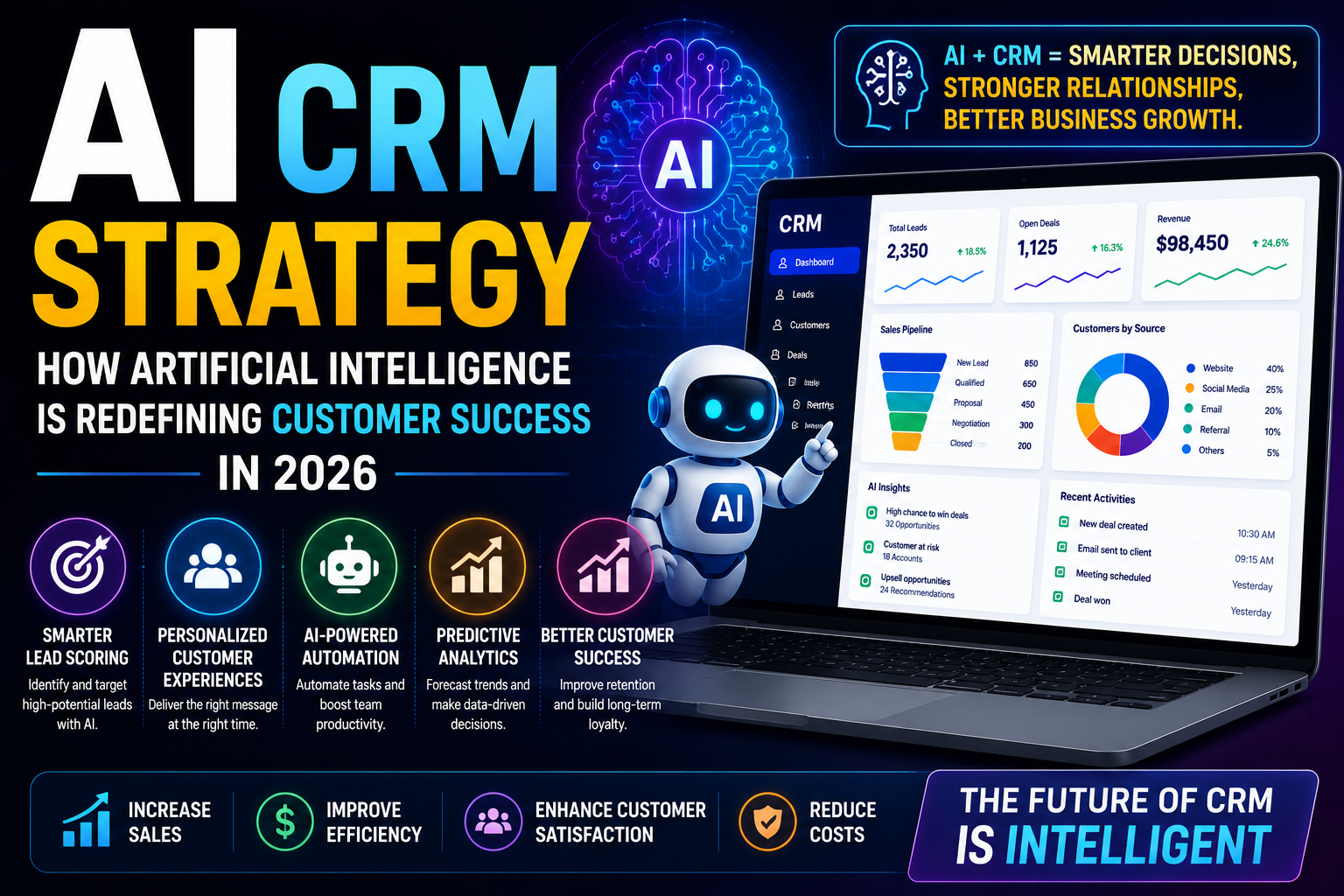
Customer Relationship Management (CRM) has evolved from a simple contact database into an intelligent business platform. In 2026, businesses are no longer asking whether they should use Artificial Intelligence—they’re asking how to build an effective AI CRM strategy.
An AI CRM strategy combines customer data, machine learning, predictive analytics, and automation to help businesses make faster decisions, improve customer engagement, and increase revenue. Instead of reacting to customer behavior, companies can now predict needs, automate repetitive tasks, and deliver highly personalized experiences at scale.
Whether you operate an eCommerce store, SaaS business, healthcare organization, or financial institution, an AI-powered CRM strategy can transform the way you attract, manage, and retain customers.
What Is an AI CRM Strategy?
An AI CRM strategy is the process of integrating artificial intelligence into your CRM system to automate customer management and improve business performance.
Rather than relying only on manual processes, AI continuously analyzes customer interactions and provides recommendations that help teams make smarter decisions.
A modern AI CRM strategy focuses on:
- Customer intelligence
- Sales automation
- Marketing personalization
- Customer service automation
- Predictive analytics
- Workflow optimization
Why Businesses Need an AI CRM Strategy
Businesses collect thousands of customer interactions every day. Without AI, much of this valuable information remains unused.
An effective AI CRM strategy helps businesses:
- Understand customer behavior
- Predict future buying decisions
- Improve customer retention
- Increase sales efficiency
- Reduce operational costs
- Automate repetitive work
- Deliver personalized experiences
Companies that adopt AI-driven CRM gain a competitive advantage by responding faster and making data-driven decisions.
Key Components of an AI CRM Strategy
Intelligent Customer Profiles
AI builds dynamic customer profiles by analyzing:
- Purchase history
- Website activity
- Email engagement
- Customer support interactions
- Social media behavior
This creates a complete view of every customer.
Predictive Lead Scoring
Instead of contacting every lead equally, AI identifies which prospects are most likely to become customers.
AI evaluates:
- Engagement level
- Buying intent
- Previous interactions
- Demographic information
- Online behavior
Sales teams can focus on high-value opportunities.
Personalized Customer Journeys
AI automatically creates personalized experiences based on customer behavior.
Examples include:
- Personalized product recommendations
- Dynamic website content
- AI-generated emails
- Targeted advertisements
- Customized onboarding
This increases engagement and conversion rates.
Automated Sales Processes
AI reduces manual work by automating:
- Lead assignment
- Follow-up reminders
- Proposal generation
- Appointment scheduling
- Pipeline updates
Sales representatives spend more time closing deals.
AI-Powered Customer Support
Modern CRM systems include AI assistants capable of:
- Answering customer questions
- Resolving simple issues
- Creating support tickets
- Escalating complex requests
- Providing instant responses 24/7
This improves customer satisfaction while reducing support costs.
AI CRM Strategy for Marketing Teams
Marketing departments benefit significantly from AI-powered CRM.
AI helps marketers:
- Segment audiences automatically
- Predict campaign performance
- Personalize email marketing
- Optimize advertising budgets
- Recommend the best communication channels
These capabilities increase ROI while reducing manual effort.
AI CRM Strategy for Sales Teams
Sales professionals use AI CRM to:
- Prioritize leads
- Forecast revenue
- Identify upselling opportunities
- Detect buying signals
- Automate follow-ups
- Track customer engagement
The result is faster sales cycles and higher conversion rates.
AI CRM Strategy for Customer Success
Customer success teams use AI to monitor customer health and identify potential risks.
AI can detect:
- Reduced product usage
- Negative customer sentiment
- Support ticket frequency
- Renewal risks
Businesses can take proactive actions before customers decide to leave.
Best Practices for Implementing an AI CRM Strategy
To maximize success:
- Set clear business objectives.
- Keep customer data clean and accurate.
- Choose an AI-enabled CRM platform.
- Automate repetitive workflows first.
- Train employees on AI features.
- Monitor KPIs and optimize regularly.
- Ensure compliance with privacy regulations.
Common Challenges
While AI CRM offers significant advantages, businesses may encounter:
- Poor data quality
- Resistance to change
- Integration complexity
- Security concerns
- Initial implementation costs
A phased implementation plan can help overcome these challenges.
Future Trends in AI CRM
Over the next few years, AI CRM platforms will include:
- Autonomous AI sales agents
- Voice-controlled CRM assistants
- Generative AI for proposals and emails
- Real-time customer emotion analysis
- Hyper-personalized marketing
- Predictive customer lifetime value
- AI-powered revenue forecasting
These innovations will make CRM systems even more intelligent and efficient.
Frequently Asked Questions
What is an AI CRM strategy?
An AI CRM strategy is a business approach that combines CRM software with artificial intelligence to automate customer management, improve sales, and enhance customer experiences.
Why is AI important in CRM?
AI helps businesses analyze customer data, automate repetitive tasks, predict customer behavior, and improve decision-making.
Can small businesses use AI CRM?
Yes. Many modern CRM platforms provide affordable AI features suitable for startups and small businesses.
What are the biggest benefits of an AI CRM strategy?
The biggest benefits include improved productivity, personalized customer experiences, better lead management, predictive analytics, and increased revenue.
Conclusion
An AI CRM strategy is becoming essential for businesses that want to compete in a data-driven world. By combining artificial intelligence with customer relationship management, organizations can automate operations, strengthen customer relationships, improve sales performance, and make smarter decisions based on real-time insights. As AI technology continues to advance, businesses that invest in AI-powered CRM strategies today will be better prepared for the future.