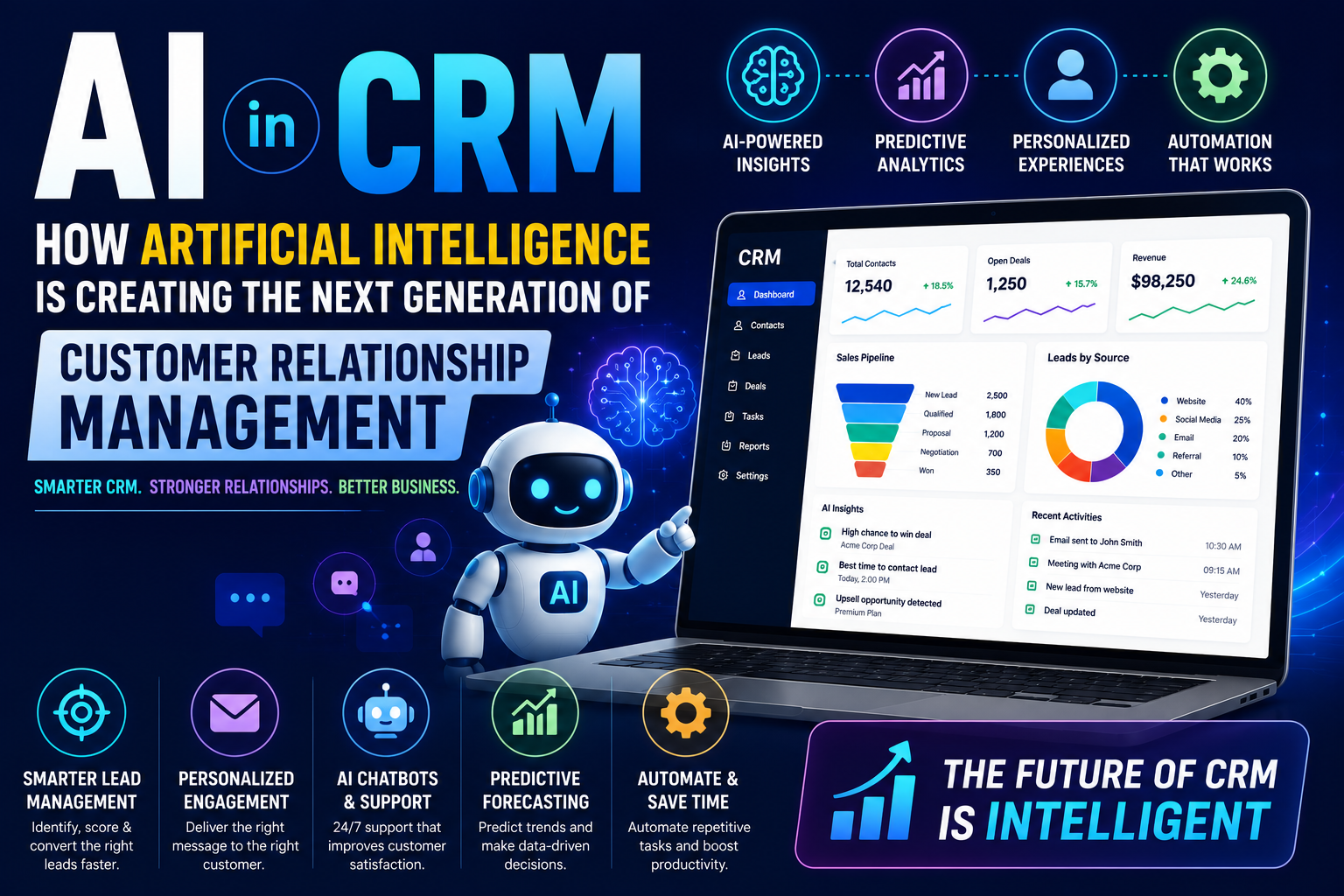
Customer Relationship Management (CRM) has always been about building stronger relationships with customers. But in today’s fast-moving digital world, businesses need more than just a database of contacts—they need intelligent systems that can analyze data, predict customer behavior, and automate repetitive tasks. This is where AI in CRM is making a significant impact.
Artificial Intelligence (AI) is transforming CRM platforms into smart business assistants. Instead of simply storing customer information, AI can identify sales opportunities, personalize customer interactions, forecast trends, and automate everyday workflows. Whether you’re running a small business or a large enterprise, AI-powered CRM can help improve efficiency, increase revenue, and deliver exceptional customer experiences.
What Is AI in CRM?
AI in CRM refers to the integration of Artificial Intelligence technologies into Customer Relationship Management software. AI enables CRM systems to learn from customer data, recognize patterns, and provide intelligent recommendations.
Common AI technologies used in CRM include:
- Machine Learning (ML)
- Natural Language Processing (NLP)
- Predictive Analytics
- Generative AI
- Conversational AI
- Intelligent Automation
These technologies help businesses work faster, make smarter decisions, and provide more personalized customer experiences.
Why AI in CRM Is Important
Modern businesses interact with customers through multiple channels, including email, websites, mobile apps, social media, and live chat. Managing all this information manually is difficult.
AI-powered CRM helps businesses:
- Automate repetitive tasks
- Understand customer preferences
- Predict buying behavior
- Improve customer service
- Increase sales productivity
- Deliver personalized marketing campaigns
By turning customer data into actionable insights, AI helps organizations stay competitive.
Key Benefits of AI in CRM
1. Intelligent Lead Scoring
AI analyzes customer behavior, website visits, email interactions, and demographics to rank leads based on their likelihood to convert.
Advantages
- Better lead prioritization
- Higher conversion rates
- More efficient sales process
2. Personalized Customer Experiences
AI studies customer preferences and purchase history to deliver personalized recommendations, offers, and communication.
Businesses can create:
- Personalized email campaigns
- Product recommendations
- Customized promotions
- Tailored customer journeys
This increases customer satisfaction and loyalty.
3. Sales Forecasting
AI examines historical sales data and market trends to predict future sales performance.
Businesses can forecast:
- Revenue
- Sales opportunities
- Seasonal demand
- Customer growth
This helps management make informed strategic decisions.
4. Workflow Automation
AI automates repetitive administrative tasks such as:
- Data entry
- Follow-up emails
- Appointment scheduling
- Lead assignments
- Report generation
Automation saves time and reduces human errors.
5. AI Chatbots and Virtual Assistants
AI-powered chatbots provide instant support by answering frequently asked questions, capturing leads, scheduling appointments, and assisting customers 24/7.
Benefits include:
- Faster response times
- Reduced support costs
- Improved customer satisfaction
6. Predictive Customer Analytics
AI identifies patterns in customer behavior to predict future actions, such as:
- Purchase likelihood
- Customer churn
- Upselling opportunities
- Cross-selling opportunities
This allows businesses to take proactive actions before problems arise.
7. Smarter Marketing Campaigns
AI helps marketers improve campaign performance by:
- Segmenting audiences automatically
- Optimizing email timing
- Personalizing content
- Tracking customer engagement
The result is higher click-through rates and better return on investment (ROI).
8. Better Customer Retention
Retaining existing customers is more cost-effective than acquiring new ones.
AI identifies customers at risk of leaving and recommends retention strategies, including:
- Personalized discounts
- Loyalty rewards
- Follow-up communication
- Special offers
Industries Using AI in CRM
Many industries benefit from AI-powered CRM, including:
- Healthcare
- Banking
- Insurance
- Retail
- E-commerce
- Real Estate
- Education
- Hospitality
- Manufacturing
- Technology
Challenges of AI in CRM
While AI offers many advantages, businesses should also consider:
- Data privacy and security
- Initial implementation costs
- Employee training
- Data quality issues
- Integration with existing systems
Addressing these challenges ensures successful AI adoption.
Future of AI in CRM
The future of AI in CRM is exciting, with innovations such as:
- Voice-enabled CRM assistants
- Generative AI for customer communication
- Hyper-personalized marketing
- Autonomous customer support
- Predictive customer journeys
- AI-driven business intelligence
- No-code workflow automation
These advancements will continue to reshape customer relationship management in the years ahead.
Frequently Asked Questions
What is AI in CRM?
AI in CRM is the use of Artificial Intelligence within Customer Relationship Management software to automate tasks, analyze customer data, and improve decision-making.
How does AI improve CRM?
AI improves CRM by automating workflows, scoring leads, predicting customer behavior, personalizing marketing, and enhancing customer support.
Is AI in CRM suitable for small businesses?
Yes. Many modern CRM platforms offer affordable AI features that help small businesses increase productivity and improve customer engagement.
What are the biggest advantages of AI in CRM?
The biggest advantages include automation, better customer insights, improved sales forecasting, personalized marketing, enhanced customer support, and increased business efficiency.
Conclusion
AI in CRM is transforming the way businesses manage customer relationships. By combining intelligent automation with powerful analytics, AI-powered CRM systems help organizations increase productivity, improve customer experiences, and drive sustainable growth. As technology continues to evolve, businesses that invest in AI-enabled CRM solutions will be better equipped to meet customer expectations and stay competitive in the digital marketplace.